Malaysian consumers form an opinion about a website in a fraction of a second, and there's data to prove it. Users form a first impression in 0.05 seconds, 88% won't return after a bad experience, and 75% judge credibility based on design alone.
For small and medium businesses trying to grow online, that single statistic changes the whole conversation around when to invest in UI/UX design. It's no longer a question of whether design matters. It's a question of timing.
Problem: SMEs Are Going Digital, But Design Is an Afterthought
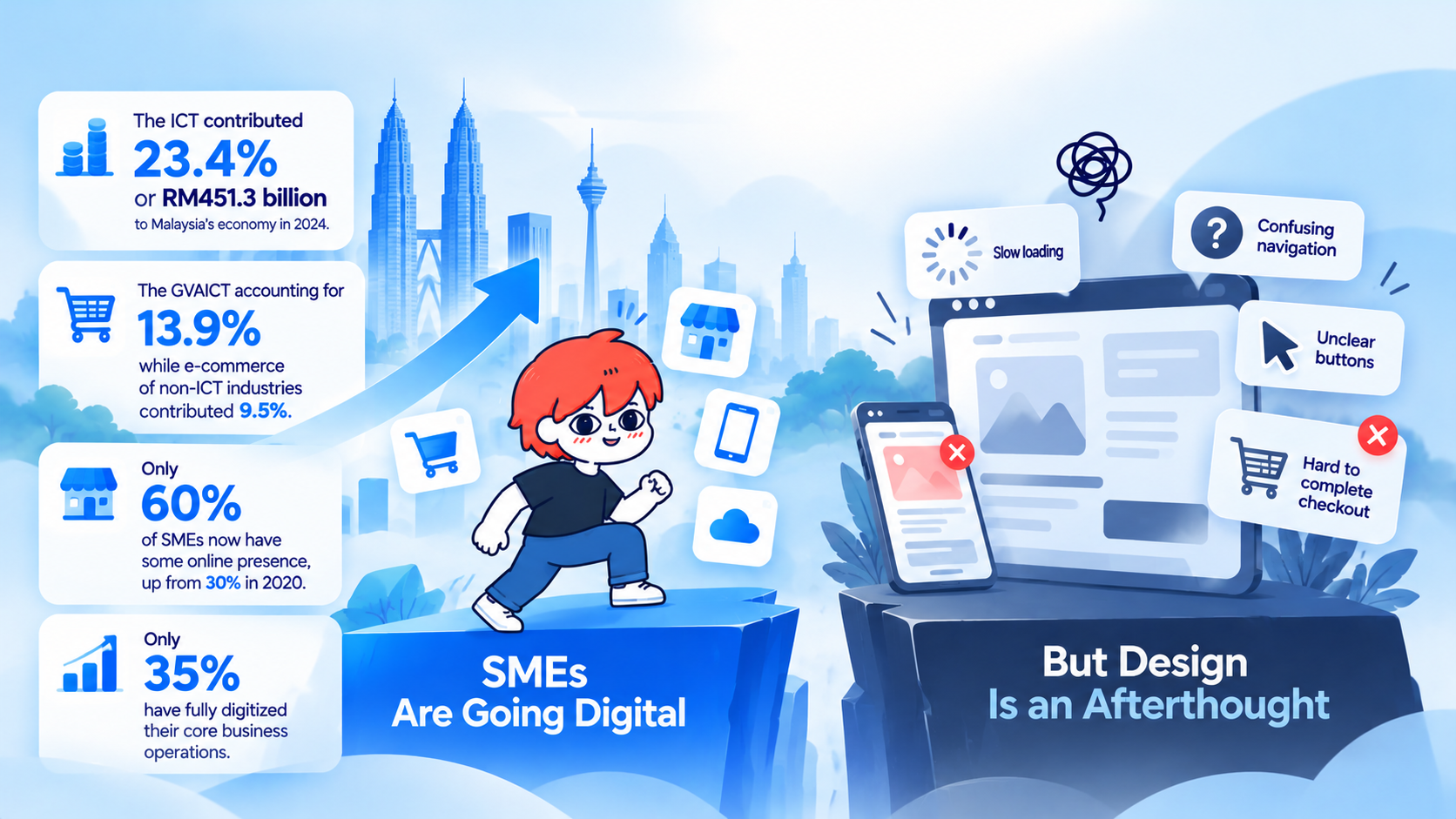
Malaysia's digital economy is accelerating fast. The ICT contributed 23.4 per cent or RM451.3 billion to Malaysia's economy in 2024, with the GVAICT accounting for 13.9 per cent while e-commerce of non-ICT industries contributed 9.5 per cent. Yet adoption is uneven.
Only 60% of SMEs now have some online presence, up from 30% in 2020, and only 35% have fully digitized their core business operations.
Here's the gap most business owners miss: getting a website or app live is only step one. If it's confusing, slow, or hard to navigate, it quietly costs sales every single day. Many founders treat design as decoration rather than a growth lever, which is a costly mistake. As one industry analysis puts it, a confusing checkout flow, a slow-loading page, or a button that does not look clickable are small friction points that cost you customers, and UI/UX design is the discipline of eliminating that friction.
Why the "When" Matters More Than the "If"
The financial case for investing is well documented.
Every RM1 invested in UX can return up to RM100, delivering a potential 9,900% ROI, and 55% of companies are currently conducting user experience testing. On the conversion side, good UI can boost conversions by 200%, while strong UX can boost them by up to 400%.
Over the long run, design-led companies outperformed the S&P by 228% over 10 years.
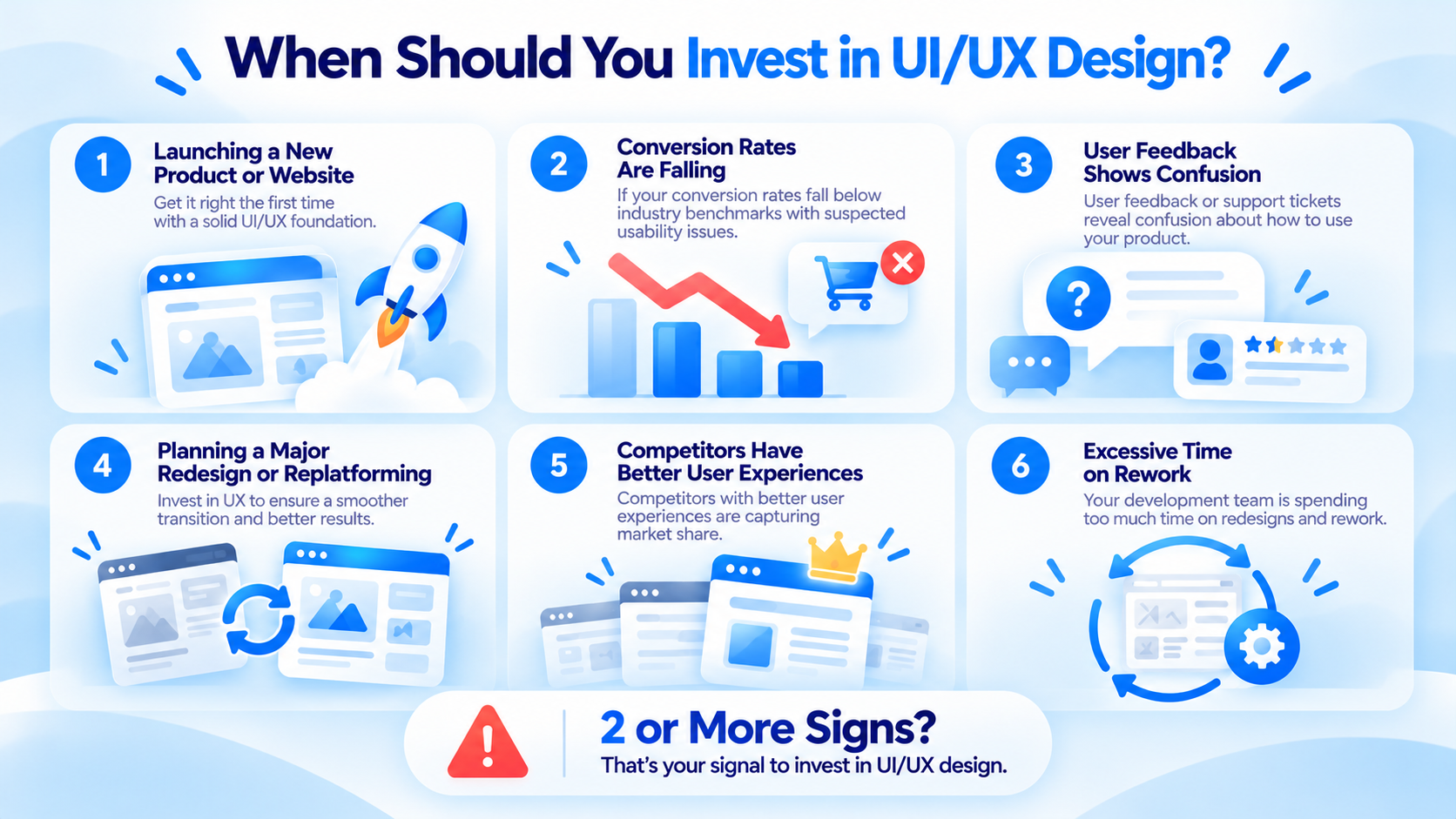
Those numbers sound impressive, but an SME doesn't need to chase a Fortune 500 redesign budget to benefit. What matters is recognizing the trigger points. According to design consultancy Clustox, businesses should invest when they notice specific warning signs:
- Launching a new product or website and wanting to get it right the first time.
- Current conversion rates falling below industry benchmarks with suspected usability issues.
- User feedback or support tickets revealing confusion about how to use the product.
- Planning a major redesign or replatforming project
- Competitors with better user experiences capturing market share.
- Development team spending excessive time on redesigns and rework
If two or more of those sound familiar, that's your signal.
Five Practical Moments to Invest
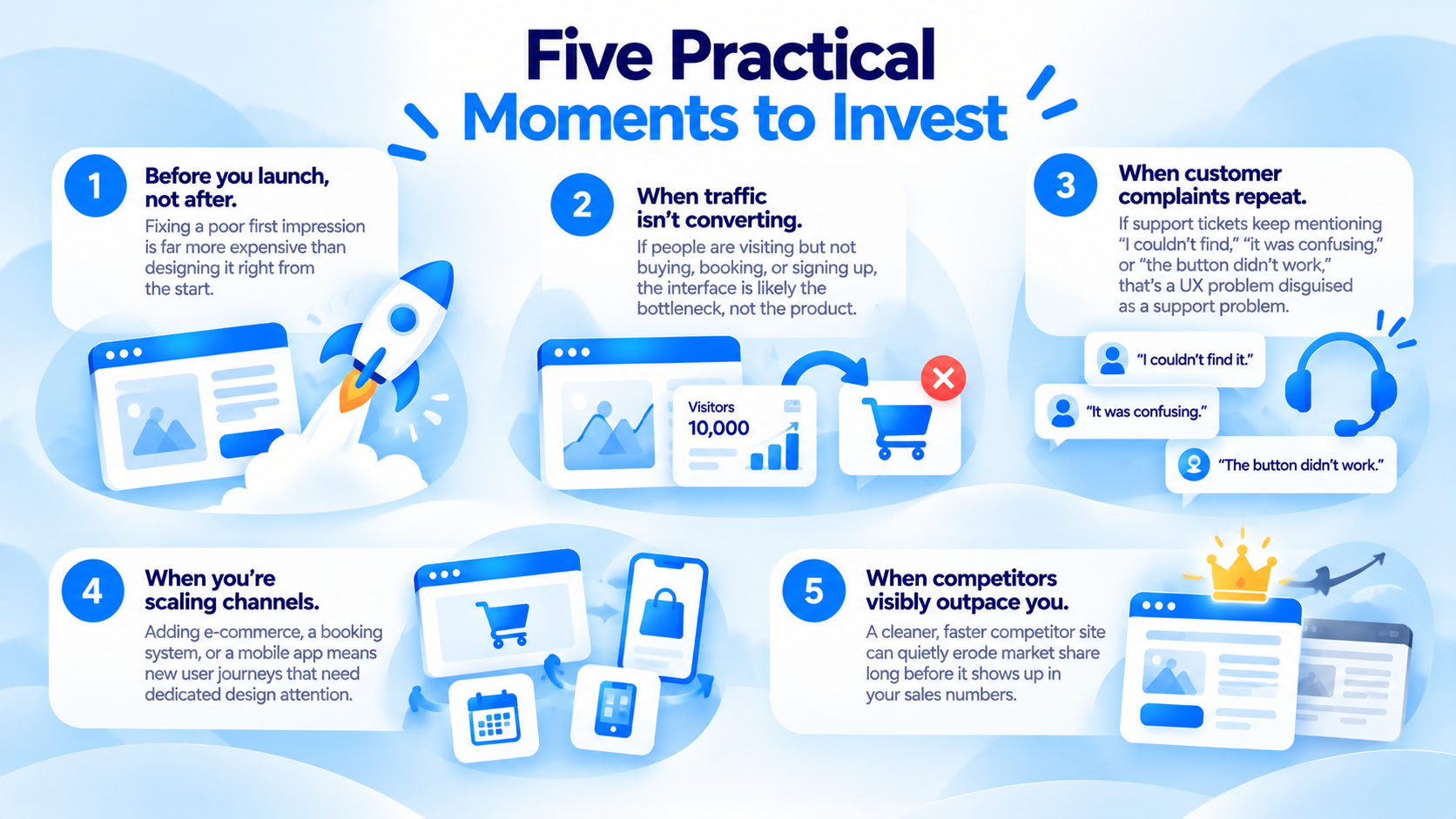
1. Before you launch, not after. Fixing a poor first impression is far more expensive than designing it right from the start.
2. When traffic isn't converting. If people are visiting but not buying, booking, or signing up, the interface is likely the bottleneck, not the product.
3. When customer complaints repeat.If support tickets keep mentioning "I couldn't find," "it was confusing," or "the button didn't work," that's a UX problem disguised as a support problem.
4. When you're scaling channels. Adding e-commerce, a booking system, or a mobile app means new user journeys that need dedicated design attention.
5. When competitors visibly outpace you. A cleaner, faster competitor site can quietly erode market share long before it shows up in your sales numbers.
A Real-World Example

Picture a Kuala Lumpur based F&B brand preparing for a seasonal campaign.
A KL F&B brand hiring a freelancer for a Ramadan campaign, posters, and social media ads is a common scenario for SMEs that need design support without a full-time hire. This is exactly the kind of project-based need where bringing in a UI/UX or graphic freelancer for a defined scope, rather than committing to permanent headcount, makes financial sense.
Learn more about the differences between UI and UX: https://www.rtist.co/blog/ui-designer-vs-ux-designer-what-s-the-difference-for-businesses-hiring-for-jobs-with-graphic-design
Actionable Tips for SMEs on a Budget
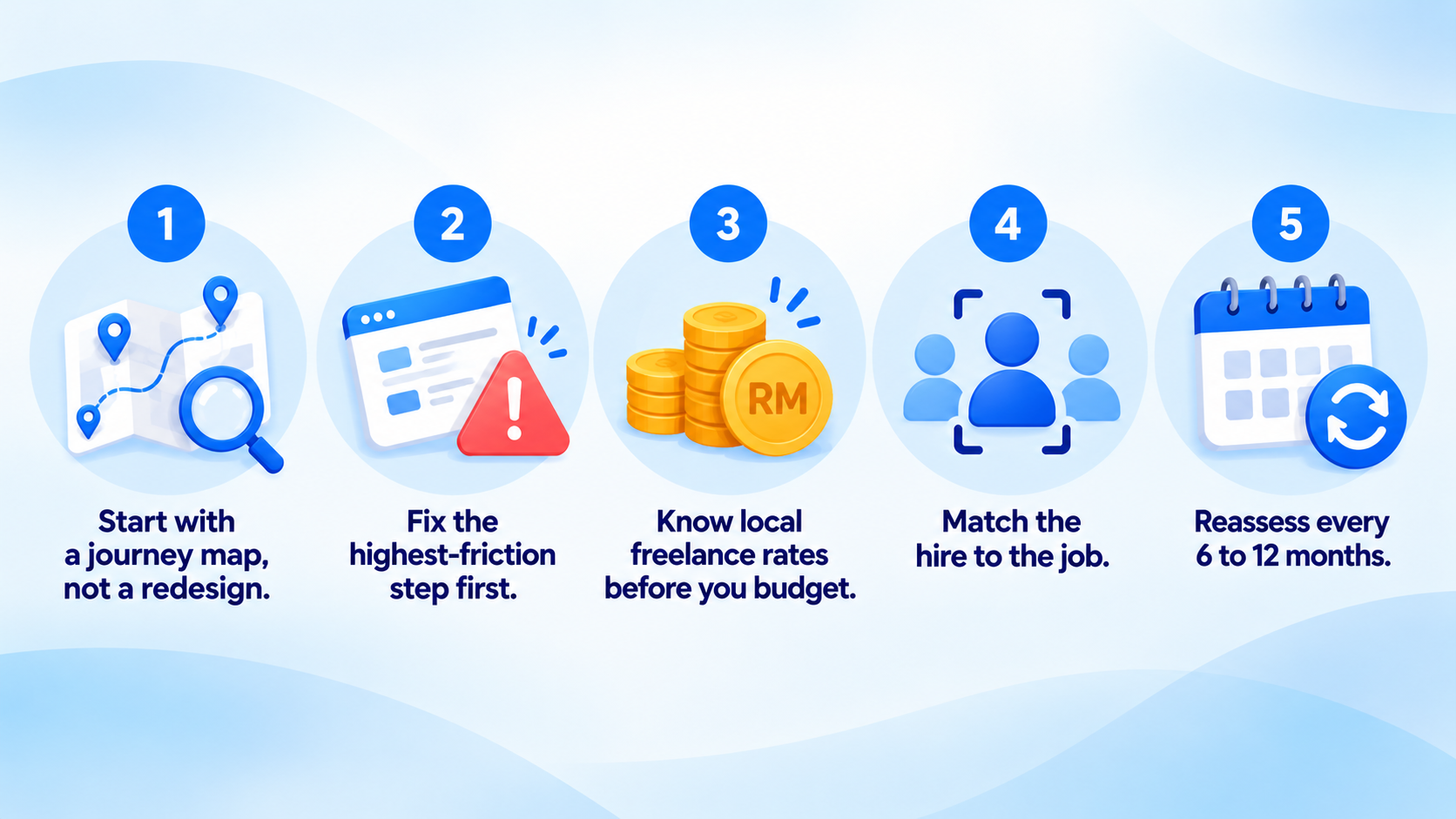
- Start with a journey map, not a redesign.Walk through your customer's path from discovery to checkout and note where they hesitate or drop off.
- Fix the highest-friction step first. You don't need a full overhaul. A better checkout flow or clearer navigation can move the needle quickly.
- Know local freelance rates before you budget.
Junior freelancers in design, writing, and basic development typically charge RM40 to 80 per hour, while senior specialists in branding, software architecture, and UX design command RM100 to 250 or more per hour.
- Match the hire to the job. A one-off landing page redesign suits a freelancer. An ongoing product needs a retainer or contract designer.
- Reassess every 6 to 12 months. User expectations and platforms shift quickly, so even a lean UX audit on a regular cadence keeps you competitive.
Learn more about the costs of UX Research: https://www.rtist.co/blog/how-much-does-ux-research-cost-in-malaysia-a-local-freelancer-s-rate-guide-for-2026

Conclusion
Design isn't a luxury reserved for big brands with big budgets. For Malaysian SMEs riding the wave of a fast-growing digital economy, the businesses that treat UI/UX as a strategic decision, not a cosmetic one, are the ones capturing the conversions their competitors are leaving behind. The right time to invest is when you notice the warning signs, not after you've already lost the customer.
Hire UI/UX Designers here: www.rtist.co